
Coastal Motor Boats
Coastal Motor Boats Thornycroft and the origins of Fast Attack Craft
This new work challenges the conventional history that the Coastal Motor Boat was the brainchild of three young naval officers. It reveals that the truth was far more complex and historically more significant. Research in extensive family archives shows that the ship builder, John I Thornycroft, and also members of his family, played a pivotal role in the boat’s emergence ahead of the three officers’ idea and that, without the Thornycrofts’ pre-war experience in designing surface skimming racing boats, the technologically advanced CMB could never have been built or operated. In particular, the intensive development work in Thornycroft’s custom-built test tank during the winter of 1915 is explored.
In this highly detailed account, the authors also analyse the original role for which these boats were specifically designed – an attack on the German High Seas Feet – and explore why such an operation never took place. Indeed, by the end of the war, despite important contributions in the Zeebrugge and Ostend raids, many regarded the CMB as a disappointment. This changed dramatically in 1919 with the Royal Navy’s intervention against the Bolsheviks, including the single boat action against the cruiser Oleg and the daring raid on Kronstadt naval base. Use of contemporary Soviet reports, and other recently emerging records, has allowed a more nuanced interpretation of these Baltic operations.
The research on the Baltic coincided with the exciting discovery of a largely intact CMB wreck in the area. The work also looks at the less well-known operations in 1919, in the Caspian Sea and North Russia, which also employed CMBs. A chapter is devoted to the work in the last two years of the war to develop unmanned remotely controlled versions of the CMB.
However, after what was lauded in Britain as a great success in the Baltic, the Royal Navy lost interest in CMBs, although the Thornycroft design continued to be built and operated by navies as far apart as those of Finland and China. The work concludes with a detailed account of the recently completed project in Portsmouth Historic Dockyard to build a replica 40ft CMB, and the lessons learnt from its build and operation that have further informed the history.
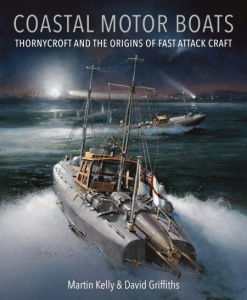
By: Martin Kelly & David Griffiths
Published: 9 October 2025
Publisher: Seaforth
ISBN: 9781036137939
Number of pages: 280